

Technology
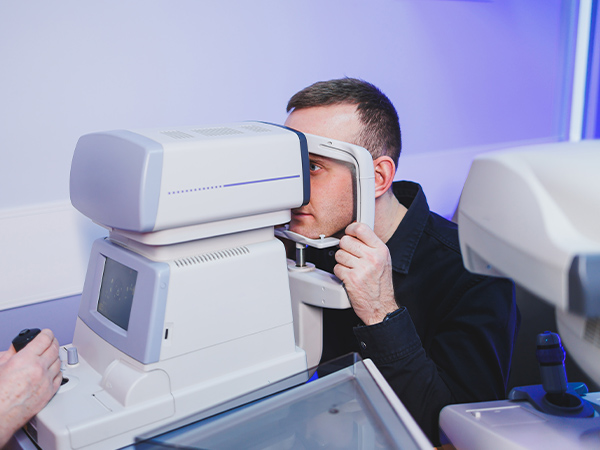
Optomap® Retinal Exam
Did you know that a range of diseases, including hypertension, age-related macular degeneration, glaucoma, diabetic retinopathy, and cancer, present themselves first in the retinas? In fact, the back of the eye is the only place in the body that doctors can view the vasculature (blood vessels) of the eye, making it a key place to look for the early signs of both systemic diseases (diseases that affect the entire body, not just the eye) and ocular problems such as retinal detachment, glaucomatous changes, and diabetic retinopathy.
The Optomap® Retinal Exam, as part of an annual eye exam, is a crucial step in identifying problems — that can threaten your vision and even your life if not caught early.
This comprehensive, state-of-the-art exam provides an ultra-wide view of the retina, which is situated at the very back of your eyes, without dilation. The retina includes a complex network of blood vessels that can be compromised by hypertension, diabetes, and other potentially serious conditions. When examined closely, the retina also alerts your doctor to glaucoma, macular degeneration, and retinal detachment, which can cause blindness if not treated promptly.
Not only is the Optomap® Retinal Exam a useful way to diagnose a range of dangerous disorders, it’s easy and comfortable for the patient and takes only minutes to perform. It also has the advantage of generating a permanent record — in the form of a digital photograph — that we keep for comparison, year after year. Such comparison allows us to provide comprehensive, long-term care and to detect changes in your eyes’ health as soon as they develop.
Lastly, the Optomap® Retinal Exam requires no pupil dilation, so our patients do not have the inconvenience of light sensitivity and blurred vision that result from dilated exams.
Mulqueeny Eye Centers is proud to offer the Optomap® Retinal Exam to our patients, as it makes diagnosing and treating eye disorders easier for both doctor and patient. Learn more about this and other diagnostic tools at our St. Louis, Missouri centers by contacting Dr. Sean Mulqueeny today.
QuantifEYE®
Low macular pigment has been associated with higher risk of macular degeneration. There is now a device called QuantifEYE® that can measure the relative health of your macula. By taking this simple test we can determine your risk level of developing macular degeneration. In addition to the test results, we will assess other risk factors you may have. Such risk factors include:
Age
Female
Family history of macular degeneration
Family history of cataracts and/or glaucoma
Body Mass Index
Smoking
Excessive exposure to the sun
The QuantifEYE® is a quick, non-invasive response test. Based on your eyes response to different levels of blue light presented, we are able to determine the level of macular pigment present in your eye. Studies indicate that low levels of macular pigment indicate higher risk of macular degeneration. A baseline measurement is taken, giving Dr. Mulqueeny your MPOD (macular pigment optical density) score. If you happen to test low to medium (low MPOD is correlated with a higher risk for AMD), he may recommend supplementation to restore depleted levels of zeaxanthin and lutein in your macula.
The doctor will then be able to determine, through follow-up screenings, if nutritional intervention is resulting in increased macular pigment. If you’ve ever wondered whether a supplement or vitamin you take is actually working, this test will tell you. We can actually measure results.
Macular degeneration has no cure, but it can be prevented. By the time you notice symptoms, some damage may have already occurred and is irreversible and that’s why prevention is key. Ask for this important test at your next eye examination. It’s not too late to take steps to preserve your vision and restore your eyes to a healthier state.
Vitamins/Supplements to Fight Macular Degeneration
Age-related macular degeneration, or AMD, which causes the loss of central vision, affects 15 million Americans. It is the number one cause of blindness among people over 55. Luckily, when caught early, macular degeneration can be stemmed before it robs you of your sight. At our St. Louis, Missouri Eye Centers, we offer some excellent nutritional supplements such as EyePromise™ Restore, that can help maintain the health of your eyes.
EyePromise™ Restore
EyePromise™ Restore is recommended for many patients who have age-related macular degeneration (AMD) or who may be at risk for the condition. It contains a patented level of zeaxanthin, plus lutein—the carotenoids (red and yellow pigments) that make up the pigment in the macula. They are powerful antioxidants that can help lower a person’s risk of AMD. While lutein is readily available in a healthy diet, research shows that even healthy, balanced diets don’t contain enough zeaxanthin to protect against AMD.
Lutein’s benefits are known, but recent studies indicate that zeaxanthin may be even more important. To get enough zeaxanthin in your diet would require the equivalent of 20 ears of corn per day to be consumed. It’s much easier to get what you need in one or two EyePromise™ Restore softgels per day.
Other beneficial ingredients found in EyePromise™ Restore are vitamins C & E, zinc, alpha lipic acid as well as omega-3 fatty acids, essential nutrients that are seriously lacking in our diet.
Zeaxanthin
How does Zeaxanthin protect the eyes?
Zeaxanthin works by protecting your macula from high-energy blue-wave light waves that damage the eye, as well as free radicals. Free radicals are harmful molecules implicated in cellular destruction (aging). They are created as natural byproducts of metabolism, as well as a result of ultraviolet and blue light entering the eye. Their creation can be accelerated by chronic fatigue, smoking, and a compromised immune system. As an antioxidant, zeaxanthin is able to neutralize or destroy these free radicals, protecting your eyes from damage from these highly reactive chemicals.
Studies have shown that the areas of the macula with the greatest concentration of zeaxanthin are the last to degenerate, and that age-related loss of this nutrient is a factor in both "wet" and "dry" macular degeneration.
EyePromise™ Restore combines 20mg of zeaxanthin with other nutritional supplements that help maintain the health of your eyes. If you are interested in EyePromise™ Restore, contact the practice of Dr. Sean Mulqueeny today.


Contact Info
Hours of Operation
- Monday 7:00am - 4:00pm
- Tuesday 8:30am - 5:00pm
- Wednesday 10:00am - 6:30pm
- Thursday 8:30am - 5:00pm
- Friday 7:00am - 4:00pm
- Saturday Closed
- Sunday Closed
© 2026 Mulqueeny Eye Centers. All rights Reserved. Accessibility Statement - Privacy Policy - Sitemap
Powered by:
